Arteta’s Gamble Pays Off: Lewis-Skelly Shines as Arsenal Tighten Grip on Title Race
When Mikel Arteta unveiled his team sheet against Fulham on Sunday, eyebrows were raised. Four changes from the midweek Champions League draw against Atletico Madrid included one bold experiment: Myles Lewis-Skelly, a teenager known for his versatility, was handed his first senior start in midfield. It was a decision that could have backfired. Instead, it transformed Arsenal’s season.
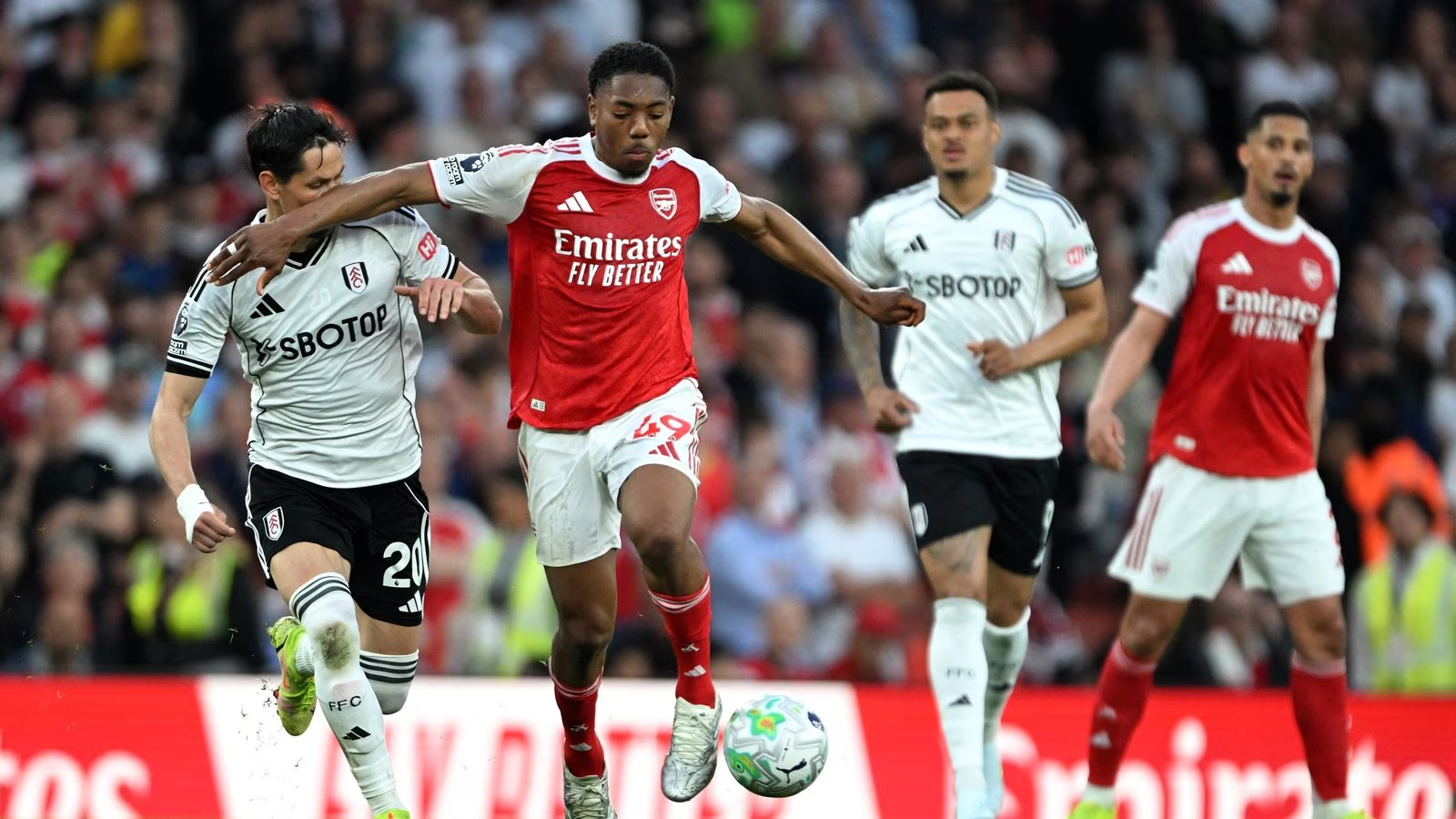
Arteta’s bold midfield experiment against Fulham paid off spectacularly, with Myles Lewis-Skelly shining in his first senior start in midfield as Arsenal cruised to a 3-0 win. The victory restored belief in Arteta’s tactical acumen and strengthened Arsenal’s grip on the Premier League title race, though Manchester City’s games in hand keep the contest alive.
The Gunners struck three times, with Gyökeres netting twice in the 9th and stoppage time of the first half, while Saka added a brilliant finish in the 40th minute.
A Tactical Masterstroke
Arteta deployed a diamond-shaped midfield, with Declan Rice and Lewis-Skelly forming a double pivot and Eberechi Eze operating as the attacking fulcrum. The absence of Martín Zubimendi, a regular in Arsenal’s midfield, was barely noticed as the new trio controlled the tempo and dismantled Fulham with ruthless efficiency.
On Lewis-Skelly playing in midfield and why it’s taken so long to play him there, Arteta said, “Because probably I don’t have a clue and maybe I should have done it earlier, I don’t know. But I have to do things when I believe that the player is ready, the team is ready and the opponent is the right one to play with him in that position. We’ve done it today, it’s the first time. It was a big risk because I knew what was going to happen, if he wasn’t this great, we would have lost the game. How do you play a kid at this age, in this scenario, in a position that he hasn’t played all season? I knew that but I had the feeling that it was the right game for him.”
Lewis-Skelly’s Coming of Age
The 19-year-old had already impressed as a left-back last season, even shining against Real Madrid in the Champions League quarter-finals. But Sunday was different. This was his audition as a midfielder, and he passed with distinction.
Passing accuracy: 97%
Possession won: 6
Duels won: 7
Fouls won: 4
He initiated Arsenal’s opener, threading a pass to Bukayo Saka, who left his marker trailing before setting up Viktor Gyökeres for a simple finish. Throughout the game, Lewis-Skelly’s positioning, composure, and energy belied his age. Wright, along with other analysts, like Paul Merson highlighted Myles Lewis-Skelly’s performance as a key factor in Arsenal’s dominant display. Wright indicated that Lewis-Skelly was a prime example of the intensity and control Arsenal needed in the middle of the pitch to secure the win, noting how he operated effectively when the game got tight.
Paul Merson on Lewis-Skelly now challenging Zubimendi,
“I’m so pleased for him. He got an opportunity and sometimes it’s so difficult to come in when you haven’t played a lot of football, especially in the Premier League, and to perform like he did. He kept it simple, he didn’t complicate anything, he played himself in the game – he did everything you want a young lad to do. He’s given Mikel a major headache because he gave you that energy, he lifted everybody, he played on the front foot, he got close to people. I’m a big fan of Zubimendi’s, but he’s been chasing the games recently. He nearly gets there – this lad was tight. Those simple passes give your top players that make everything tick together. I don’t think Zubimendi’s being doing that recently.”
Myles Lewis-Skelly on his performance in the Arsenal win over Fulham on Saturday, “I only knew I was playing in midfield in the changing room before and when I saw the team sheet I had to scratch my eyes a little! But I have to thank the manager for that. But it felt so natural and it was really special for me today.
“For me coming in to the game I had to make sure I took the energy from the crowd, go in to the first duel and be positive because when you play with confidence it really helps.
“It was just coming in and making sure I was the best version of myself. I don’t take that lightly and I make sure I recover well, eat well and I don’t take that lightly. So really pleased with today and we go again on Tuesday!”
Restoring Faith in Arteta
The victory was more than three points. It was a statement. After a string of inconsistent performances that had fans questioning Arteta’s methods, this tactical masterclass reignited belief. Arsenal now sit six points clear at the top, though Manchester City’s two games in hand keep the race finely balanced.
For supporters, the sight of Arsenal dictating play with authority was a reminder of the team’s potential. “We’ve waited 20 years for this,” one fan said. “If Arteta keeps trusting players like Skelly, the title is ours.”
The Road Ahead
Arsenal’s season is far from over. The Gunners now turn their attention to the Champions League semi-final second leg against Atletico Madrid on May 5, 2026, before resuming their Premier League run-in with three decisive fixtures: away to West Ham on May 10, at home to Burnley on May 18, and a final-day trip to Crystal Palace on May 24.
And Arteta faces another dilemma: does he stick with Lewis-Skelly in midfield or restore Zubimendi? With the Premier League and Europe both within reach, every decision carries weight.
Yet Sunday’s performance may have given Arteta his answer. In Lewis-Skelly, he may have found the missing piece of a midfield puzzle that has too often faltered under pressure. The risk paid off once. Arsenal fans will hope it pays off again, this time on the grandest stage.
Declan Rice in Tears After Historic Champions League Triumph
Arsenal midfielder Declan Rice was visibly emotional after helping his side secure a place in the UEFA Champions League final for the first time in 20 years, following a 1-0 victory over Atletico Madrid at the Emirates Stadium.
Bukayo Saka’s goal just before half-time sent Arsenal into the Champions League final for the second time in the club’s history, as they overcame Atletico Madrid in a jubilant Emirates Stadium. With the tie finely balanced after last week’s 1-1 draw in Madrid, the Gunners struck the decisive blow on 44 minutes when Leandro Trossard’s effort was parried into Saka’s path, allowing him to finish and set up a thrilling second half.
Bukayo Saka’s strike on 44 minutes fired Arsenal past Atletico Madrid 1-0 at a rocking Emirates, booking their spot in the Champions League final for the second time in history.
Rice, who delivered another tireless performance in midfield, admitted he was almost lost for words after the final whistle. Speaking to arsenal.com, he said:
“I can’t describe it to be honest with you. It’s been coming, this night at the Emirates in general, I think it’s the best night at the Emirates that I’ve witnessed, even better than the Real Madrid game last year.”
The England international praised the supporters for creating an unforgettable atmosphere, recalling how the players were greeted with flares and chants as the team bus arrived.
“I’ve not seen the Emirates like that, so a big thank you to the fans because we needed that… Even if you’re tired, it just gives you that energy to keep going, and I think they played a massive part tonight in making us win.”
Rice acknowledged the significance of the achievement for both the club and its fans, highlighting the emotional journey Arsenal supporters have endured over the years.
“This era of Arsenal fans… I’m sure this is really up there for them. So, I’m happy we’ve done it for the club and for this set of players and our manager because everyone deserves it, so, so happy.”
The victory means Arsenal will contest their first Champions League final since 2006, with a chance to lift Europe’s biggest prize for the first time in the club’s history.
Looking ahead to Budapest, Rice added:
“It’s crazy saying that. Bring it on – I’ll be ready. Budapest, I want every Arsenal fan out there. 200,000 of you, come out! Let’s try and do it because we’re going to need all the support, all the energy and let’s make it really special.”
Arsenal now stand on the brink of history, with Rice’s passion and leadership embodying the spirit of a team determined to finally conquer Europe.
Arsenal players celebrate after beating Atletico Madrid 1-0 at the Emirates Stadium to reach the Champions League final for the second time in the club’s history.
Seven Draws and a Heartbreak: The Day Benjani Mwaruwari Finally Conceded Defeat
At a waterlogged Maphisa Stadium, under the heavy skies of Zimbabwe’s 46th Independence Day celebrations, the inevitable finally happened. For the first time since taking the reins at Highlanders F.C., former Warriors captain Benjani Mwaruwari had to stare defeat in the face.
When “The Smiling Assassin,” Knowledge Musona, struck late in a compressed, high-stakes Independence Trophy (Uhuru Cup) final on April 18, 2026, he didn’t just hand reigning Premier League champions Scottland FC a 1-0 victory and the US$20,000 prize money. He also shattered a bizarre, months-long statistical anomaly that had kept Mwaruwari’s unblemished record artificially intact.
Knowledge Musona, the scorer of the Uhuru Cup-winning goal, lifts the cup
Mwaruwari’s journey at the Bulawayo giants began in January 2026, a high-profile appointment heavily influenced and bankrolled by businessman Wicknell Chivhayo, who pledged to underwrite the former striker’s salary. Expectations were sky-high. Yet, rather than a whirlwind of victories, Mwaruwari has presided over a campaign of stalemates.
Benjani Mwaruwari soon after joining Highlanders FC
Leading up to the cup final, the record looked intriguing on paper, but the underlying statistics told a story of blunt attacking impotence. In the current Premier League season, Highlanders have played seven matches. The result? Seven draws.
It began with a 1-1 stalemate against Premier League returnees Bulawayo Chiefs. A week later, in the fiery “Battle of Zimbabwe,” Mwaruwari’s men visited perennial rivals Dynamos and played out a thrilling 2-2 draw. But the momentum stopped there.
Matchday three against MWOS ended goalless. A trip to 2024 league champions Simba Bhora at Wadzanayi Stadium on March 21 yielded another 0-0. The fifth, sixth, and seventh league matches against FC Platinum, Scottland, and Kariba respectively, all ended in identical 0-0 deadlocks.
In total, over those seven league fixtures, Mwaruwari’s troops have scored just three goals, conceded three, accumulated a measly seven points, and sit in a dismal 12th place, already a daunting 12 points behind log leaders Caps United. They were technically unbeaten, but they were not winning.
Saturday’s cup final proved to be the ultimate reality check. Against a Scottland side brimming with quality, Highlanders’ fragile attacking edge was exposed.
Speaking after the final, a visibly grounded Mwaruwari kept his assessment brief. “The game was good, though we played on a muddy pitch and when you play against Scottland, a team with so much quality, if you make a mistake they will punish you,” he said.
For Scottland, the maiden Uhuru Cup title was a testament to their championship mettle. While the conditions at Maphisa were far from ideal, Scottland coach Norman Mapeza was quick to pivot the focus back to the significance of the day.
Scottland FC Coach Norman Mapeza
“The pitch was not good, but at the end of the day the people came out in their numbers to celebrate this day and we are happy to have got this result,” he said.
Mwaruwari and his depleted Bosso side had to settle for the runners-up cheque of US$10,000, but for a club of Highlanders’ stature, the financial consolation does little to mask the sporting heartbreak. They were searching for a historic 10th Uhuru Cup title to break a painful winless streak, but instead, their wait continues.
Now, the illusion of the “unbeaten run” has been stripped away, and the harsh realities of the league table remain. Mwaruwari’s men have no time to lick their wounds. The clinical edge they have severely lacked all season must be discovered urgently, as they prepare for a high-octane Bulawayo derby against Chicken Inn this Wednesday.
Scottland, meanwhile, will carry the momentum of this cup triumph back to the capital, where they face a rejuvenated Dynamos side at Rufaro Stadium on the very same day.
Dynamos: From Survival to Revival – A Tale of Grit, Glory, and Grit Again
Few stories in Zimbabwean football capture the drama, resilience, and unpredictability of the game quite like Dynamos Football Club’s journey from the brink of relegation in 2025 to becoming genuine title contenders in 2026. The Glamour Boys, long celebrated as the country’s most decorated side, have once again proven that in football, despair can quickly turn into triumph.
2025: A Season of Survival and Stunning Redemption
The 2025 campaign stands as one of the darkest chapters in Dynamos’ history. At one point, relegation felt not just possible, but inevitable. This was no longer a team chasing glory; it had become a club fighting for survival. The season exposed deep cracks both on and off the pitch—poor results, administrative dysfunction, and a glaring lack of direction dragged the Glamour Boys to the brink. For a club with one of the richest legacies in Zimbabwean football, the prospect of dropping into the lower division was once unthinkable, yet it had become a frighteningly real possibility.
Fans braced themselves for the unimaginable, watching their beloved team teeter on the edge of collapse. Then came Kelvin Kaindu, the former Highlanders coach, whose arrival brought a measure of stability at a time when hope was rapidly fading. What followed was not an immediate transformation, but a slow, stubborn resistance to collapse. Survival, when it came, felt less like an achievement and more like a narrow escape.
Kelvin Kaindu lifts the Chibuku Super Cup after guiding Dynamos to victory.
And yet, in one of football’s most striking contradictions, this same struggling side rose to conquer the Chibuku Super Cup. Against all odds, Dynamos not only survived but claimed the prestigious title, defeating Triangle United 1–0 at Gibbo Stadium. The decisive moment came from Enasio Perezo Jr, who struck after coming on as a second-half substitute, sealing victory and securing a historic third consecutive Chibuku crown, an achievement unmatched by any other team.
Enasio Perezo Jr scored Dynamos’ winner in their 1–0 Chibuku Super Cup final victory over Triangle United at Gibbo Stadium on 30 November 2025.
Three in a row. At a time when relegation seemed more likely than silverware.
But if the 2025 season ended on an improbable high, the off-season swiftly dragged Dynamos back into familiar turmoil. As the champagne dried, the cracks began to reappear. The club lost several key players in quick succession, most notably captain Emmanuel Jalai, who moved to Durban City in South Africa, along with goalkeeper Prince Tafiremutsa, midfielders Shadreck Nyahwa and Vusa Ngwenya, and the mercurial Denver Mukamba. In a matter of weeks, the core of the squad that had just delivered silverware was dismantled, leaving behind uncertainty and a team forced to rebuild almost from scratch.
Emmanuel Jalai joins Durban City
Off the field, the chaos intensified. Player contract disputes, unpaid salaries, failure to secure sponsorship, and the recurring habit of losing players for free once again painted a picture of a club trapped in administrative dysfunction. As the 2026 season approached, there were genuine fears Dynamos might not even assemble a competitive squad.
Hope, if it existed at all, arrived quietly in the form of Genesis Mangombe. Ironically, he had just guided Triangle United, last season’s strugglers, to safety and a Chibuku final… only to lose that very final to Dynamos. Now tasked with rebuilding the Glamour Boys, Mangombe inherited not just a depleted squad, but a fractured institution.
Genesis Mangombe
In the Castle Challenge Cup, a traditional curtain-raiser between league champions and cup winners, Dynamos under Mangombe suffered a humiliating 5–1 defeat to Scottland FC, one of the heaviest losses in the club’s history. For many, it merely confirmed what they had already come to believe: Dynamos were finished. Written off before a ball had even been kicked in the league, the crushing result only deepened the perception of a club in irreversible decline.
But football, as always, demanded patience. Or as the local saying goes: “Mirirai ra 3pm.” (Wait for the real game).
And when 3pm came, Dynamos answered.
2026: The Mamombe Effect and a Surprising Rebirth
His comeback was met with skepticism, but Mamombe has injected belief and tactical discipline into a squad many thought would crumble.
The results speak for themselves. Dynamos opened the season with a 2–1 away victory over TelOne FC in Gweru, setting the tone for what would follow. A hard-fought 2–2 draw against perennial rivals Highlanders came next, before a convincing 2–0 win over Bulawayo Chiefs on the road. Further victories against MWOS, last season’s title contenders, and Simba Bhora, the 2024 champions, suggested this was more than just a fleeting run of form.
After seven matches, Dynamos sit third on the table with 15 points from a possible 21—a 71% success rate, and are just one point behind league leaders CAPS United.
Pause and consider that.
This is the same team that was fighting relegation months ago. The same team that lost key players. The same team that was humiliated 5–1 in pre-season. The same team many believed would collapse under its own dysfunction.
So what changed?
Not everything. The off-field issues remain unresolved. Financial instability still looms. Structural inefficiencies persist. But on the pitch, something intangible has emerged—resilience. A refusal to be defined by chaos.
Dynamos today are not perfect. They are not even stable. But they are competitive. And in football, competitiveness is often the first step toward redemption.
This raises an uncomfortable question: how long can a club survive on resilience alone?
Because while results may temporarily mask deeper problems, history suggests that instability eventually catches up. Dynamos cannot continue to rely on miracles, last-minute recoveries, and emotional comebacks. At some point, structure must replace improvisation.
Yet for now, they remain one of the most compelling stories in Zimbabwean football—a club that refuses to die, no matter how many times it is buried.
From the brink of relegation to the edge of a title race, Dynamos have once again reminded everyone why they are called the Glamour Boys.
Not because they are flawless—but because, even in chaos, they find a way to matter.